
Designing, Growing, Nurturing
30 minutes with Will Elliot, designer, artist, and founder of Biocrafting.Studio.
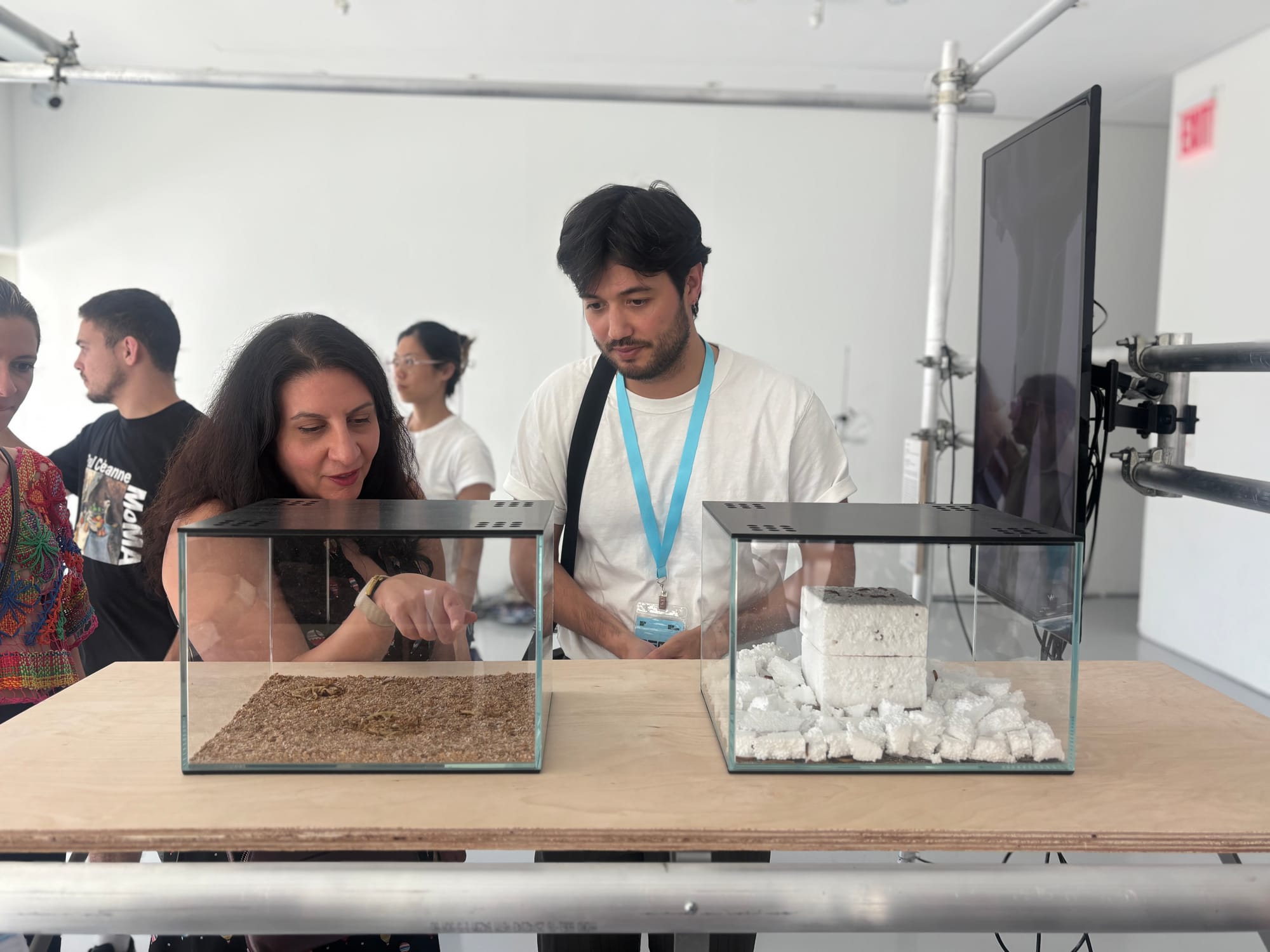
Will showing BioBAT Art Space Director Elena Soterakis the mealworms eating potatoes and styrofoam at the Demo exhibit in the New Museum last Friday.
William Takao Eliot is known, in certain circles, as the mealworm guy. He's fine with that.
"There's something about it that's surprising that mealworms are even involved. Something that people might consider ugly, or creepy, is able to produce something beautiful. There's a whole spectrum of different beings out there that deserve the limelight, and deserve to be learned about and researched. I think that's part of what draws me to looking at bacteria and mealworms, using creativity, art, and design to shine a light on this, so that people who aren't usually engaged with it are able to engage with it."
He's currently a member of the Genspace Biomaterials Studio, where he's at the halfway point of a new project.
The Mealworm Guy
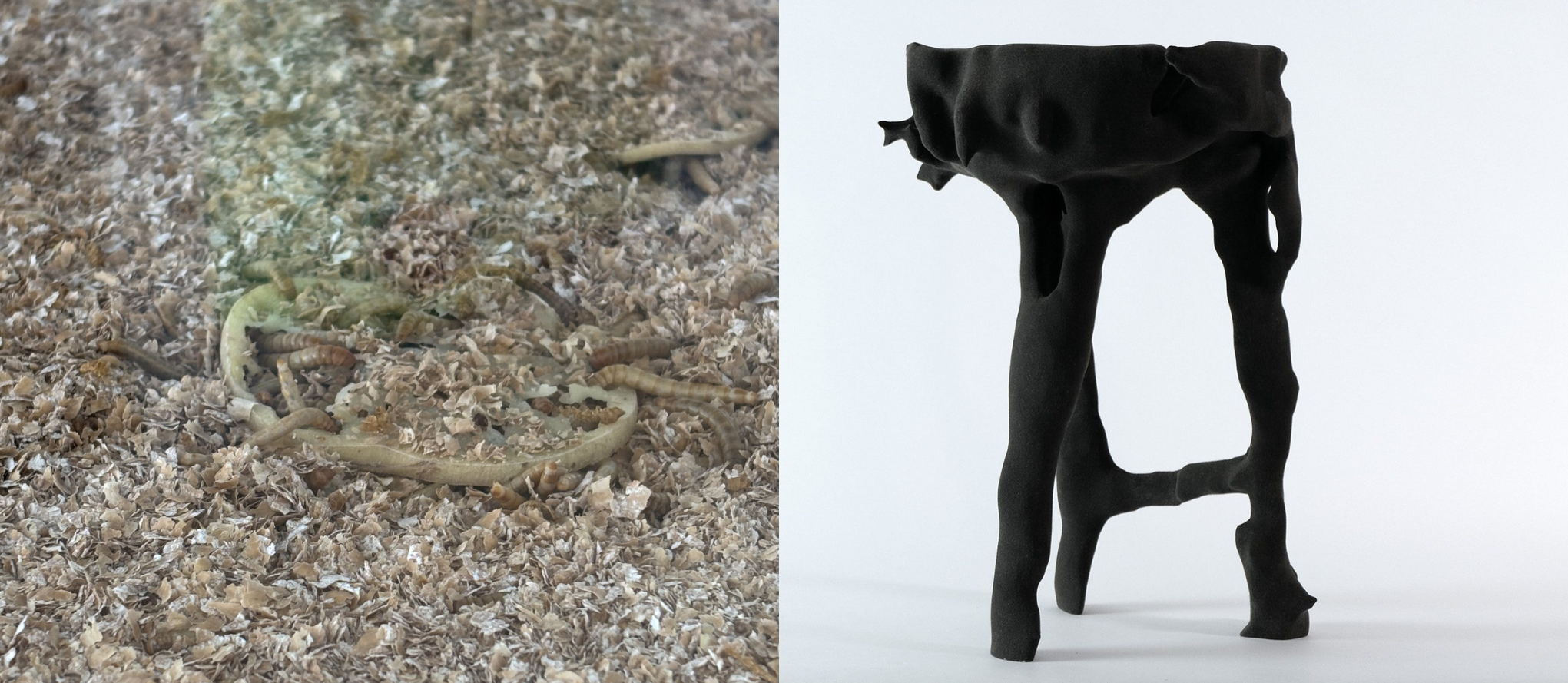
The project that earned Will this nickname is called Digested Objects, an interspecies design experiment investigating whether you can collaborate with non-humans. In this case, mealworms, which carry a bacteria that allows them to digest polystyrene. Will was interested in the mealworms’ ability to digest plastic, but also the idea that they could work on a problem collaboratively.
"A lot of the research was only focused on the function. They weren't really thinking about the ecosystem and how humans could potentially work with non-humans. I was like, what could be a process that really puts them on a similar level as me as a designer, or even positions them higher in the hierarchy?"
This led him to inject sugar into polystyrene, so the mealworms would follow the sugar trail and then go off on their own. The tunnels they carved became the designs. He scanned them and scaled them up.
"I like to call the mealworms the creative directors. I become the maker. You relinquish control, and you end up with designs that you just don't get as a human."
The mealworm project became one of the defining threads of Biocrafting.Studio, Will's practice. He defines it as "a studio that radically collaborates with nature” and asks “What is the most extreme way that you can collaborate with nature that gets to a result that benefits everyone in that ecosystem?"
“It poses a lot of questions around how we design objects in the current industrial manufacturing landscape, where everything is 100% replicable. Can you make objects with non-humans where you really value each one, because it's a new collaboration and a new output you wouldn't be able to replicate again?"
On Collaboration, Again
There’s an ongoing debate on collaboration in the bioart world about what it really means to collaborate with an organism–as opposed to using it as a means to an end.
"Collaboration is such a human word. It's got a lot of cultural baggage from being used in modern workplaces. But I don't think it's as binary as that. It's almost like a sliding scale from exploiting to collaborating, and if your intention is to work with something, then you're not at that using space. And the further you get toward collaboration, that's when ethics comes in. With the mealworms, the ethics are, you want to make sure they're getting a varied diet and not only eating polystyrene. So I have two units where I transfer them between polystyrene and organic food waste."
"I'm trying to move away from extraction — the main way design and manufacturing works right now — toward principles like growing and nurturing. Those are far more in line with where we should be going."
Kintsugi with Microbes
Will's current project in the Biomaterials Studio is a Kintsugi process made with microbes. Kintsugi is the traditional Japanese craft of repairing broken ceramics with gold lacquer, making the repair visible rather than hiding it. Will is half Japanese, and the project is more personal and culturally rooted.
"I think science can feel a bit separated from how people live their lives. Part of what I'm trying to do is bring it into my own cultural upbringing having grown up in Japan, always being interested in Japanese crafts and the objects I had around my home, and ask how those processes influence the way I approach science."
The organism he's working with is S. pasteurii, a bacteria found commonly in soil. S. pasteurii produces an enzyme called urease, which breaks down urea into ammonia and carbonate. In media containing calcium, S. pasteurii can cause calcium carbonate crystals (e.g. limestone) to form, a process known as bio-cementation. Will applies it to substrates of sand, bone ash, and fibers.
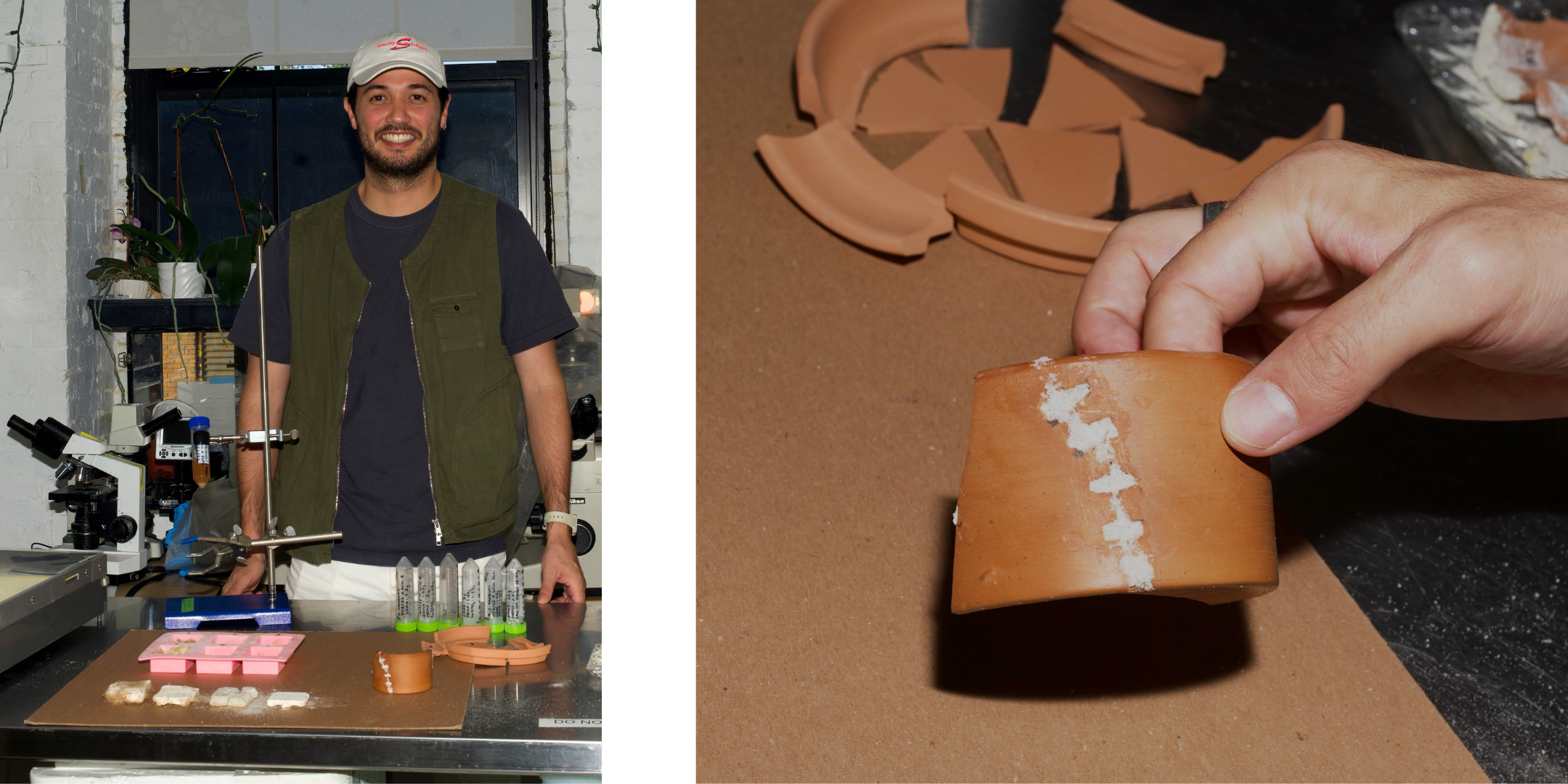
"The bone ash in the urns becomes the source of calcium you need to start the precipitation process. That idea really got its hooks into me, giving life to something we think of as dead. It ties into Japanese animism, the idea that inanimate objects have a spirit. To literally give it animation through bacteria, and have the bone ash be the source of life. The whole object becomes one living ecosystem. It's talking about big themes like death and funeral rituals that everyone has experienced at some point. And then offering a new perspective on how bio can play a role in that."
Getting the bio cement to adhere to ceramics without extracting all the moisture from the media was tricky. He tried holding it up with different structures, used wax and sand, and after a conversation with Brian, one of the co-leads, Will turned to a stonemason technique — soaking the ceramics in water first.
"All these different craft methods are coming into the process. You can only do this at Genspace. There's no other place where you can really do all those different things step by step, because they just don't have the setup, or you don't get the autonomy and freedom to try that stuff out."
At Monday’s GBS Bioartist Incubator Work in Progress show, Will gave people a look at his bio cement samples and some early Kintsugi experimentation on terracotta.
Demo 2026 at the New Museum
Will is also a member of NEW INC., a program at the New Museum that brings a cohort of artists together for a year of mentorship, connections, and development. Today is the last day you can see Digested Objects at Demo 2026 at the New Museum. See more of Will's work at Biocrafting.studio and on IG @takaomakesthings.
The Biomaterials Studio is a community-driven biomaterials research group at Genspace, exploring the intersection of materials, biology, and design. Members are currently at the halfway point of their Bioartist Incubator Program, developing materials and exploring narratives with biocement, food waste, SCOBY, mycelium, pigments, and more. The Annual GBS Bioartist Exhibit is September 18, 2026 at Flux IV.
Coming Up at Genspace
Workshops and events are offered both in person and virtually. Please read carefully before signing up and reach out if you have any questions.

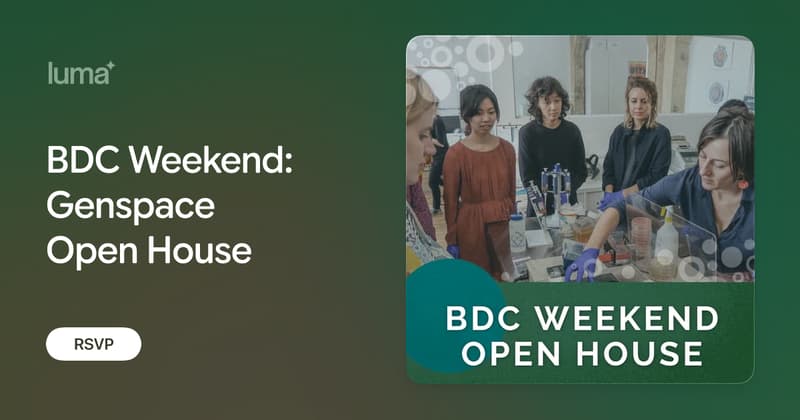
Saturday, June 13

Thursday, June 25
Community Events • Opportunities • Jobs
Community Events
• 6/11, 12 - Biodesign Challenge
• 6/12 - Pride Night at the Museum: Forces of Nature
• 6/13 - NYC Resistor: Machine Yearning
• 6/18 - Facts Machine: Sex Cells, Science Comedy and Trivia Inspired by Mating
• 6/26 - UPROSE Comedy Night
• 6/30 - Pioneer Works Scientific Controversies: Heart, Blood, and Soul
Opportunities
• Volunteer at BDC Summit & Symposium 2026
• NYU Game Center Incubator
• Fish Are Teachers Artist Residency Program Oko Farms
• NYC H2O Paid Summer Eco-Internship
• Fort Greene Park Development Summer Internship
Jobs
• Multiple Positions, NYC Department of Cultural Affairs
• Part Time STEM Educator, Liberty Science Center
• Special Agent STEM - Physical Science Background, FBI
• Applied Research Associate, J.P. Morgan
• Technical Sales Specialist, Thermo Fisher Scientific
• Geologist/Environmental Scientist
• Associate Director, Fellowships & Professional Learning, NYAS